

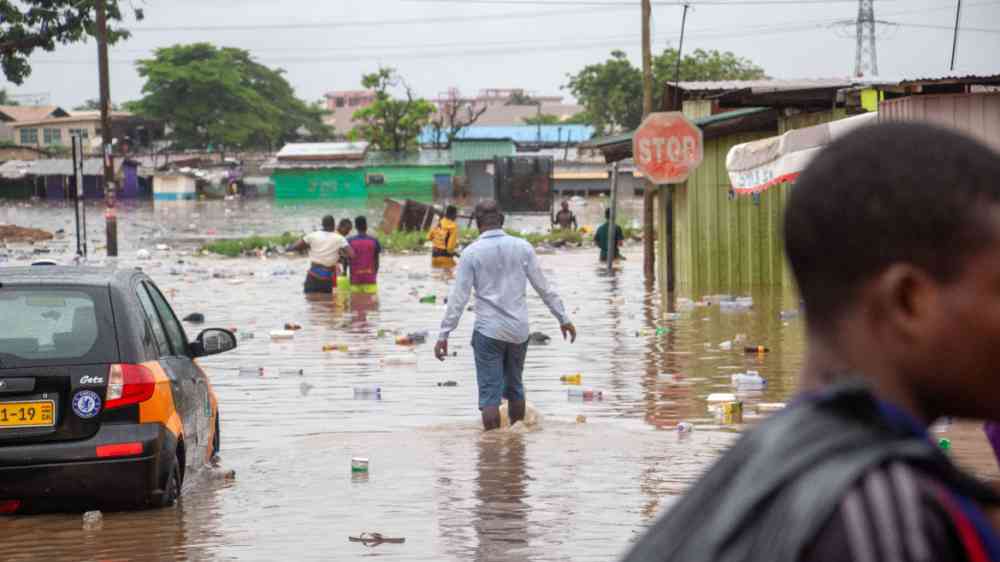
Recent flooding in Ghana has once again exposed the country’s persistent sanitation challenges. Large quantities of improperly disposed plastic waste, paper, and other refuse frequently block drainage systems, resulting in severe flooding, environmental degradation, and the destruction of homes and businesses.
Beyond the immediate economic losses, poor waste management contributes to public health risks and places an increasing financial burden on the government.
Rather than treating waste solely as a sanitation problem, Ghana can transform it into an economic opportunity by developing a community-based recycling ecosystem that creates employment, supports local industries, and improves environmental sustainability.
Proposal
The Government of Ghana, through the Ministry responsible for Sanitation and Water Resources, should establish a Smart Community Recycling and Waste Management Initiative. The programme would be implemented in partnership with Metropolitan, Municipal and District Assemblies (MMDAs), beginning with pilot communities before expanding nationwide.
The initiative would focus on three key objectives:
• Improving household waste segregation.
•Promoting recycling industries.
•Leveraging digital technology to improve waste collection efficiency.
•Community Education
A successful recycling programme depends on public participation. Before implementation, sanitation officers would receive training on modern waste management and recycling practices.
These officers would work alongside Assembly Members, Unit Committees, and community leaders to educate households on proper waste segregation. Residents would be taught to separate waste into categories such as:
•Organic waste
•Plastics
•Glass
•Paper and cardboard
Continuous public education through schools, churches, mosques, markets, radio stations, and community meetings would reinforce the programme.
Smart Waste Bins
Each participating household would receive color-coded waste bins designed for specific waste categories.
The bins could be fitted with affordable Internet of Things (IoT) sensors capable of monitoring:
•Bin fill levels
•Collection status
•Improper usage where technically feasible
•Location identification
Rather than requiring frequent manual inspections, sanitation officers would receive digital notifications when bins are nearly full, allowing waste collection vehicles to operate more efficiently.
The system would also generate useful data for planning waste collection schedules and allocating sanitation resources.
Incentive Programme
Encouraging voluntary compliance is likely to produce better long-term results than relying solely on penalties.
Households that consistently comply with waste separation guidelines could receive incentives such as:
•Electricity credit subsidies
•Water bill discounts
•Property rate rebates
•Mobile money rewards funded through recycling revenues
•Rewarding positive behavior would increase participation while fostering a culture of environmental responsibility.
Enforcement
To ensure fairness, households that repeatedly fail to comply after receiving education and warnings could face enforcement measures under existing sanitation regulations.
Possible enforcement measures include:
•Written warnings
•Community sanitation service
•Monetary fines imposed through the appropriate legal process
•Enforcement should prioritize education first, with penalties reserved for persistent non-compliance.
•Supporting Local Recycling Industries
One of the most significant benefits of the programme would be the development of local recycling industries.
The government could empower entrepreneurs by providing:
•Low-interest loans
•Equipment financing
•Tax incentives
•Technical training
•Business incubation support
These businesses could process recyclable materials into products such as:
•Plastic furniture
•Plastic paving blocks
•Roofing sheets
•Packaging materials
•Recycled paper products
•Glass products
•Organic compost and fertilizer
This approach would convert waste into valuable raw materials while creating sustainable employment opportunities.
Pilot Implementation
The programme should begin with a pilot project within a single electoral area.The pilot would evaluate:
•Public participation
•Cost effectiveness
•Collection efficiency
•Recycling rates
•Reduction in indiscriminate dumping
•Community satisfaction
•Lessons learned would guide improvements before expansion to other districts.
Expected Benefits
The initiative would deliver multiple national benefits, including:
•Cleaner communities
•Reduced flooding caused by blocked drains
•Lower waste management costs
•Increased recycling rates
•New employment opportunities
•Growth of local manufacturing industries
•Better environmental protection
•Improved public health
•Data-driven sanitation planning
•Increased citizen participation in environmental stewardship
Recommendations
To maximise the success of the initiative, the Government should:
•Develop a national household waste segregation policy.
•Introduce smart waste management technologies gradually through pilot programmes.
•Strengthen partnerships with private recycling companies.
•Provide financial support for local recycling enterprises.
•Integrate sanitation education into school curricula.
•Use data collected from smart waste systems to improve urban planning and waste collection services.
Additional Suggestions
A few additional enhancements listed below could make the policy much more feasible and cost-efficient:
•Use QR codes or RFID tags rather than advanced sensors. Fully sensor-equipped bins for every household could be expensive. Using QR codes or RFID tags to identify households during collection may be a more affordable first step, with smart sensors introduced later in high-density urban areas.
•Create neighborhood recycling hubs. Instead of every district having a full recycling plant initially, designated collection centers could aggregate recyclable materials before transporting them to regional processing facilities, reducing capital costs.
•Introduce an Extended Producer Responsibility (EPR) scheme. Require manufacturers and importers of plastic packaging to contribute financially to the collection and recycling system. This would provide a sustainable source of funding and align with international best practices.
•Develop a national sanitation dashboard. Data from collection vehicles, recycling centers, and smart bins could feed into a central platform that helps the Ministry and MMDAs monitor collection performance, identify illegal dumping hotspots, and improve planning.
Kofi Osei Bonsu Berchie
Ghana Communication Technology University
PhD Computer Science Student


