


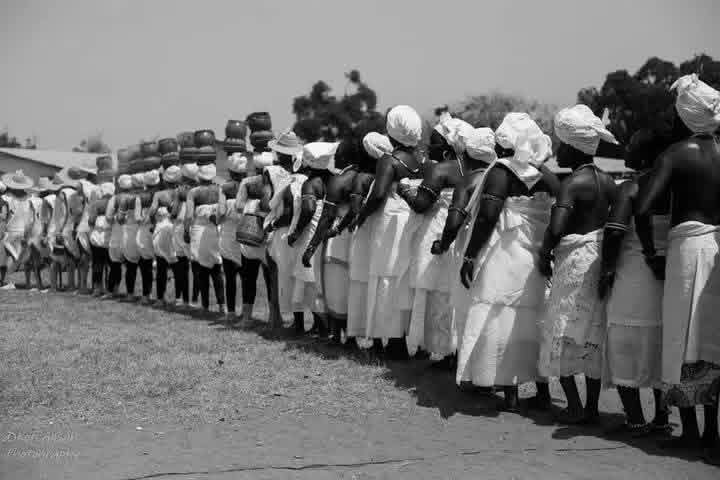
Compiled by Abigail Grit
For many Ewe people across southern Ghana, Togo and Benin, a name can carry far more than personal identity. It may reflect family history, spiritual beliefs, social status and cultural values passed down through generations.
Among the most distinctive are names associated with Yeʋe (also written Yewe or Yeve), a traditional religious institution linked to thunder, lightning, justice, discipline and divine authority. Although the public practice of the institution has declined in many communities over the past century, its names remain an important part of Ewe cultural heritage.
What is Yeʋe?
Yeʋe is one of several traditional religious institutions found among some Ewe communities in present-day Ghana, Togo and Benin.
Ethnographers have described it as a highly structured religious fraternity associated with moral discipline, ritual observance and community life. Some scholars also note historical links between Yeʋe traditions and the wider Vodun religious heritage of the Gbe-speaking peoples.
Traditionally, initiates underwent periods of instruction led by priests (Midawo) and priestesses (Minawo). The training extended beyond ritual practice to include community responsibilities, respect for elders, ethical conduct and knowledge of ancestral customs.
Before the spread of formal Western education, institutions such as Yeʋe formed part of indigenous systems through which many young people learned social values, leadership and communal obligations.
During the colonial era and throughout the twentieth century, the spread of Christianity, formal education, urbanisation and changing social attitudes contributed to a decline in the public practice of many traditional religious institutions, including Yeʋe in some communities.
As a result, some families stopped using traditional Yeʋe names, while younger generations often grew up without knowing the meanings or histories behind them.
Researchers and cultural historians say documenting such names helps preserve an important part of Ewe linguistic and cultural heritage, regardless of an individual’s religious beliefs.
The Meaning of Yeʋe Names
Unlike many personal names, Yeʋe names often carry symbolic or spiritual meanings. In many communities, they may refer to sacrifice, wisdom, divine justice, mystery, guardianship or moral responsibility.
Because these names have been transmitted largely through oral tradition, interpretations can vary between families, shrines and communities.
The meanings below reflect explanations preserved within parts of the Yeʋe tradition and should not be regarded as the only accepted interpretations.
Examples of Male Yeʋe Names
Agbo – Traditionally associated with the sacrificial ram and symbolic ideas of sacred authority.
Agbodzi – Interpreted in some traditions as referring to access to sacred mysteries.
Agbodzihu – Associated with guardianship and hidden spiritual knowledge.
Agbolete – Linked with the idea of an acceptable or pure sacrifice.
Dafliso – Traditionally interpreted as symbolising the relationship between the serpent and thunder.
Dawuso – Understood in some communities to express the importance of wisdom over physical strength.
Humali – Associated with the mystery or incomprehensibility of divine power.
Husunu – Commonly understood as referring to an initiate or devotee of the Yeʋe institution
Miheso – Interpreted as invoking the extension of Yeʋe’s power.
Somabe – Associated with the belief that divine justice cannot be avoided.
Sowu – Understood as affirming the supremacy or authority of Yeʋe.
Examples of Female Yeʋe Names
Agbowugbe – Associated with sacrifice and atonement.
Dadolo – Traditionally interpreted as “the serpent has spoken” through wisdom or proverbs.
Dashie – Understood in some communities as referring to a female devotee or disciple.
Hugbedzi – Linked with following the sacred voice or calling of Yeʋe.
Hushie – Commonly interpreted as referring to a female initiate.
Sodalor – Associated with the extension of Yeʋe’s influence.
Sodolo – Traditionally understood as expressing that Yeʋe has spoken.
Sogbedzi – Linked with living according to Yeʋe’s guidance.
Sotorwogbe – Often interpreted as “the voice” or “word” of Yeʋe.
Preserving Cultural Heritage
Linguists and historians note that traditional names can serve as valuable records of language, philosophy and social history.
Even where traditional religious practice has changed, names often preserve ideas that have shaped communities for generations.
For many Ewe families, understanding these names is less about religious observance than about recognising an important aspect of their cultural identity.
As older generations pass on, researchers say documenting oral traditions including the meanings attached to names may help preserve knowledge that might otherwise be lost.
While interpretations differ across communities, Yeʋe names continue to offer insight into the history, beliefs and cultural heritage of many Ewe people in Ghana, Togo, Benin and the wider African diaspora.
Source: The Heritage Chronicle Africa