


Written By Flavia Abane Ayolka, MBA, CA
For many Ghanaians abroad, sending money home is an extension of family life. A transfer from Boston, New York, London or Toronto may pay school fees, cover a parent’s medical bills, support a family business or help relatives manage everyday costs.
Research on Ghana finds that remittances fund not only consumption but also household investment in education, housing and health, while reducing the likelihood of poverty (Adams & Cuecuecha, 2013).
The scale of these flows makes the investment question hard to ignore.
The Bank of Ghana reports that remittance inflows were roughly US$4.6 billion in 2024 and rose to nearly US$7.8 billion in 2025, about six per cent of GDP and now larger than foreign direct investment (Asiama, 2026).¹
Ghana is therefore asking how its financial relationship with the diaspora can move beyond transfers toward longer-term investment.
The Bank of Ghana and Ministry of Finance are developing a National Remittance Strategy that considers diaspora bonds, collective investment schemes and foreign-currency products to channel diaspora resources into infrastructure, small and medium-sized enterprises (SMEs) and capital-market development. The Ghana Investment Promotion Centre (GIPC), through its Diaspora Desk, connects Ghanaians abroad with investment opportunities (Ghana Investment Promotion Centre, n.d.).
This is an important policy direction, but there is a missing middle in the conversation.
Much of the discussion concentrates on mobilising diaspora capital: building trust, creating instruments, improving the investment climate and developing institutions capable of attracting diaspora savings. Recent work on Ghana by the International Growth Centre (IGC) highlights the trust deficit, a weak evidence base and the need for institutional harmonisation as barriers to scaling diaspora investment (Asare, 2025). These are genuine constraints, and they should be addressed.
But suppose they are. Suppose a diaspora-focused vehicle raises US$100 million: investors trust its governance, the regulatory structure is credible, and Ghanaians abroad are ready to commit savings. Someone still has to decide which opportunities deserve the capital. That is where capital mobilisation ends and capital allocation begins.
Across my work in investment analysis, strategic finance and capital planning in Ghana and the United States, I have kept returning to one question: what separates capital that is merely deployed from capital that creates lasting value?
Finance research has long held that investment selection involves more than obtaining financing. Graham and Harvey’s survey of 392 chief financial officers documented the central role of capital-budgeting and present-value techniques in corporate investment decisions, alongside real differences in how firms evaluate projects and risk (Graham & Harvey, 2001).
The diaspora-investment literature, by contrast, has focused on why diaspora members invest, how governments can attract their savings, and how instruments such as diaspora bonds can be structured, with national identity, development goals, institutional credibility and vehicle design all shaping willingness to invest (Dolan & Zeitz, 2024; Ketkar & Ratha, 2007).
This article takes up a narrower question within that conversation: once diaspora capital has been mobilised, what disciplines can improve the decisions governing where it is deployed?
I propose five practical tests: the Value-Creation Test, the Assumption Test, the Alternative-Use Test, the Execution and Governance Test, and the Accountability and Learning Test. They are not a new empirical model but a practitioner framework that brings established investment principles to bear on the specific problem of diaspora capital allocation. Throughout, I use a single illustrative case, a hypothetical diaspora-backed agro-processing project seeking GH¢50 million, to show how each test works.

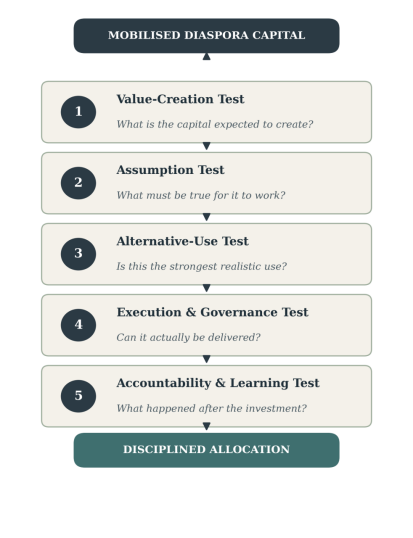
1. The Value-Creation Test: What is the capital expected to create?
The first test is deceptively simple: what is the economic logic of the investment?
Investment proposals are easily dominated by headline figures: project size, forecast revenue, jobs created, production capacity, capital raised. Those measures can be useful, but they do not establish that an investment creates value. A project can grow sales while producing weak returns if the growth demands excessive operating expenditure, financing, working capital or follow-on investment. A large project may generate substantial activity yet be a weaker use of capital than a smaller alternative. Work on corporate capital allocation emphasizes that management’s choices about how capital is deployed are central to long-term value creation (Mauboussin & Callahan, 2014); Jensen’s (1986) classic free-cash-flow framework similarly shows how excess capital can be directed toward value-destroying investments when managerial discipline and incentives are weak.
A disciplined investment case should state plainly how value will be created or protected. For a manufacturing project, the thesis may be expanded capacity, import substitution, lower unit costs or higher exports; for agribusiness, reduced post-harvest losses or greater domestic processing; for a growing small business, productive assets that increase capacity or distribution reach. Not every project creates value through new revenue. Infrastructure, resilience and technology investments may do so by reducing disruption, protecting operations or raising productivity. The point is not to force every investment into one financial story, but to make the economic rationale clear before the numbers are used to justify it.
Take the hypothetical agro-processing facility. The proposal projects strong sales growth and 100 new jobs, which is encouraging but not a complete case. An investor should still ask what processing constraint the facility solves, whether raw-material supply is sufficient, what margin remains after labour, energy, logistics and financing, and whether more capital will be needed before projected capacity is reached. The question is not whether the project creates activity, but whether the full economics justify the capital committed.
2. The Assumption Test: What must be true for the investment to work?
A financial model can look precise: revenue forecast to the cedi, returns to the decimal, payback and discounted cash flows modelled in detail. But precision in the output does not remove uncertainty in the inputs. Research on executive decision-making documents a persistent optimism bias in such forecasts, in which planners anchor on a best-case path and underweight the range of things that can go wrong (Lovallo & Kahneman, 2003). Assumptions about demand, pricing, inflation, foreign exchange, construction costs, financing, margins and timing can each move the outcome materially.
So the second test asks: what must be true for the case to hold? For every material assumption, investors should know where it came from, what evidence supports it, who owns it, and what happens if it is wrong.
Suppose the agro-processing case assumes the plant reaches 80 per cent capacity utilisation within two years. That single figure invites a chain of questions. Are supply arrangements and customer demand in place? Is the forecast based on comparable facilities? If utilisation reaches only 60 per cent, output would be roughly a quarter below the modelled level, potentially weakening margins materially depending on the project’s pricing, fixed-cost structure and financing burden. What if machinery costs rise before procurement, or construction runs nine months late and pushes first revenue into a later, costlier year?
Sensitivity and scenario analysis do not predict the future; they make the sources of uncertainty visible. The conversation shifts from “the model says this project earns X” to “these are the conditions under which it earns X,” a shift that matters especially for diaspora investors evaluating projects from another country.
3. The Alternative-Use Test: Is this the strongest realistic use of the capital?
Investment decisions do not happen in isolation, and capital has an opportunity cost: money committed to one project cannot fund another, and a viable investment is not necessarily the best available. The question is therefore not only “is this project good?” but “compared with realistic alternatives, is this where the capital should go?”
The GH¢50 million facility might deliver acceptable returns. But suppose an existing processor could be expanded for GH¢30 million to deliver 80 per cent of the additional capacity at materially lower execution risk. That does not make the original proposal bad; it changes the decision. On this comparison the expansion produces more capacity per cedi and starts sooner, and the newbuild has to justify its extra GH¢20 million with something the expansion cannot offer. Viability is not the same as superiority.
The same logic applies to individual investors. In a survey experiment with the Pakistani diaspora in the United States, for example, Dolan and Zeitz (2024) found that national pride and a stake in economic development, more than conventional returns alone, shaped willingness to invest in home-country bonds. But that does not make the diaspora a single investor type. A retiree seeking capital preservation, a professional building long-term wealth and an entrepreneur wanting direct business exposure need different products. A mature ecosystem should recognise this heterogeneity rather than treat “the diaspora” as one category.
4. The Execution and Governance Test: Can the investment actually be delivered?
A compelling model does not execute a project; institutions and people do. That makes execution capacity and governance part of the investment case, not an afterthought once capital is approved. Who owns delivery? Is scope defined? Are land, permits and infrastructure dependencies resolved? Are capital requirements reasonably complete? What milestones must be met before further capital is released, who can authorise scope changes, and how will investors know the capital is still used for its approved purpose?
These questions hit the economics directly. Delay pushes cash flows later; an underestimated capital requirement lowers returns; weak controls let scope and cost expand without re-testing the original case; poor reporting lets deteriorating performance stay hidden. Existing work already stresses trust and credible institutions. The IGC’s Ghana study names trust as a central constraint (Asare, 2025), and Ghanaian institutions increasingly agree: GIPC has called for diaspora capital to flow into transparent, well-governed structures (Ghana Investment Promotion Centre, 2026), and the Bank of Ghana has emphasised investor protection and regulatory frameworks in its diaspora-finance work (Asiama, 2026; Bank of Ghana, 2026).
The implication is straightforward: governance is not only about trust; it is a financial variable. And sometimes the right answer after reviewing execution readiness is not “yes” or “no” but “not yet.”
5. The Accountability and Learning Test: What happened after the investment?
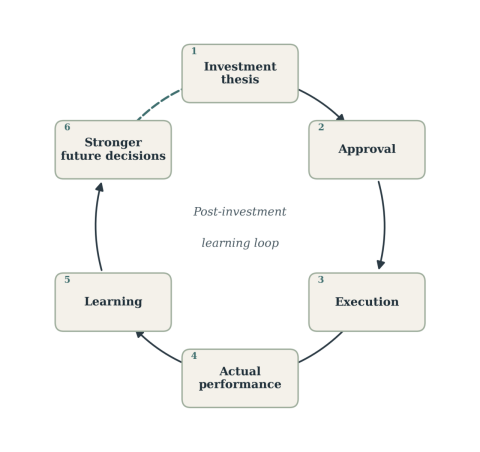
Capital approval should not end the analysis. Research on capital-investment post-audits argues that comparing actual outcomes with original assumptions improves later decisions (Neale & Holmes, 1990); that logic applies directly to diaspora investment. Large-sample evidence from transportation infrastructure projects, for instance, finds that the cost estimates used to approve them are systematically and significantly optimistic (Flyvbjerg, Holm, & Buhl, 2002), a pattern that becomes visible, and correctable, only when actual outcomes are compared with the original case. If GH¢50 million was approved, what was actually spent? If operations were due in June, when did they begin? If a project forecast a level of sales, employment or capacity, what was achieved, and when results differed materially from the business case, what explains the gap?
The aim is not to assign blame but to build institutional learning. If projects in one sector consistently cost 20 per cent more than forecast, future underwriting should price that in. If timelines repeatedly prove optimistic, assumptions should change. If one governance structure reliably produces stronger execution than another, future structures should reflect it. The result is a feedback loop:

For diaspora investment specifically, it also builds trust that rests on a measurable track record rather than on promises.
Turning the framework into practice
One practical step is for diaspora-focused funds and vehicles to adopt a common investment-decision memorandum for material projects. It need not be identical across sectors, since infrastructure, manufacturing, technology, agriculture and private-company deals demand different metrics and due diligence. But a minimum standard could require each material investment to state its value-creation thesis, identify critical assumptions and sensitivities, weigh realistic alternatives, document execution and governance arrangements, and define in advance how performance will be judged. The goal is to standardise decision discipline, not judgment.
After investments mature, managers could also report, at least in aggregate, how actual results compared with initial expectations. That would turn diaspora investment from a series of individual transactions into a system capable of learning.
A note on scope
These five tests do not replace sector-specific due diligence, securities regulation, legal review or professional underwriting, and they will not carry equal weight across asset classes: a sovereign diaspora bond, an infrastructure fund, a private SME stake and a listed equity product each demand different analysis. The agro-processing project used throughout is illustrative only; it is not intended to represent the range of Ghanaian opportunities or the performance of diaspora investments generally. The framework is a practitioner reflection on one narrow problem: how to introduce consistent decision discipline between mobilising diaspora capital and deploying it productively.
Building a second lane for diaspora savings
None of this means household remittances are economically inferior because they flow outside formal financial products. Research on Ghana shows remittances already finance meaningful investment in human and physical capital, including education, housing and health (Adams & Cuecuecha, 2013), and the Bank of Ghana recognises their role in household expenses, healthcare, education, rent and construction (Bank of Ghana, 2025). The opportunity is not to replace remittances but to build a second lane for diaspora households and professionals with investible savings beyond immediate family needs.
The opportunity is continental. The African Development Bank (AfDB) estimates remittances to Africa reached roughly US$104.8 billion in 2024 and calls diaspora finance one of the continent’s largest and most stable sources of external financing (AfDB, 2026). The challenge is ensuring the additional capital is not merely mobilised but allocated with discipline.
Ghana’s diaspora-investment agenda should therefore be judged not only by how much capital it attracts, but by the quality of the decisions that follow. Mobilisation gets capital through the door; allocation determines what happens next. The more consequential question is no longer only “how much diaspora capital can Ghana mobilise?” but “how well can Ghana allocate it?”
Note
¹ Figures as presented by the Bank of Ghana Governor (Asiama, 2026). The Bank’s own Summary of Economic and Financial Data reports a higher 2024 total on a different measurement basis; the finding that remittances now exceed foreign direct investment holds on either basis.
References
Adams, R. H., Jr., & Cuecuecha, A. (2013). The impact of remittances on investment and poverty in Ghana. World Development, 50, 24–40. https://doi.org/10.1016/j.worlddev.2013.04.009
African Development Bank. (2026). African Economic Outlook 2026: Mobilizing Africa’s development financing at scale in a fragmented world.
Asare, J. (2025). Mobilising diaspora capital for Ghana’s growth: A policy and market study. International Growth Centre.
Asiama, J. P. (2026). Speech by Governor Dr. Johnson Pandit Asiama at the Maiden Diaspora Roundtable Programme. Bank of Ghana.
Bank of Ghana. (2025). Updated guidelines for inward remittance services by payment service providers (Notice No. BG/GOV/SEC/2025/25).
Bank of Ghana. (2026). BI-Monthly Publication of Questions From The Media – May 2026.
Dolan, L. R., & Zeitz, A. O. (2024). Migration and development finance: A survey experiment on diaspora bonds. The Review of International Organizations, 19(2), 185–215. https://doi.org/10.1007/s11558-023-09505-4
Flyvbjerg, B., Holm, M. K. S., & Buhl, S. L. (2002). Underestimating costs in public works projects: Error or lie? Journal of the American Planning Association, 68(3), 279–295. https://doi.org/10.1080/01944360208976273
Ghana Investment Promotion Centre. (n.d.). Diaspora Desk.
Ghana Investment Promotion Centre. (2026). GIPC CEO calls for structured diaspora investment to drive growth.
Graham, J. R., & Harvey, C. R. (2001). The theory and practice of corporate finance: Evidence from the field. Journal of Financial Economics, 60(2–3), 187–243. https://doi.org/10.1016/S0304-405X(01)00044-7
Jensen, M. C. (1986). Agency costs of free cash flow, corporate finance, and takeovers. The American Economic Review, 76(2), 323–329.
Ketkar, S. L., & Ratha, D. (2007). Development finance via diaspora bonds: Track record and potential (Policy Research Working Paper No. 4311). World Bank.
Lovallo, D., & Kahneman, D. (2003). Delusions of success: How optimism undermines executives’ decisions. Harvard Business Review, 81(7), 56–63
Mauboussin, M. J., & Callahan, D. (2014). Capital allocation: Evidence, analytical methods, and assessment guidance. Journal of Applied Corporate Finance, 26(4), 48–74. https://doi.org/10.1111/jacf.12090
Neale, C. W., & Holmes, D. E. A. (1990). Post-auditing capital projects. Long Range Planning, 23(4), 88–96. https://doi.org/10.1016/0024-6301(90)90156-X
Author bio
Flavia Abane Ayolka, MBA, CA, is a strategic finance and investment professional with experience across investment banking, professional services, corporate strategy, healthcare finance and enterprise investment planning in Ghana and the United States. She holds an MBA from Cornell University’s Samuel Curtis Johnson Graduate School of Management and is a Chartered Accountant (CA). Her work focuses on capital allocation, investment decision-making and emerging-market competitiveness.


