


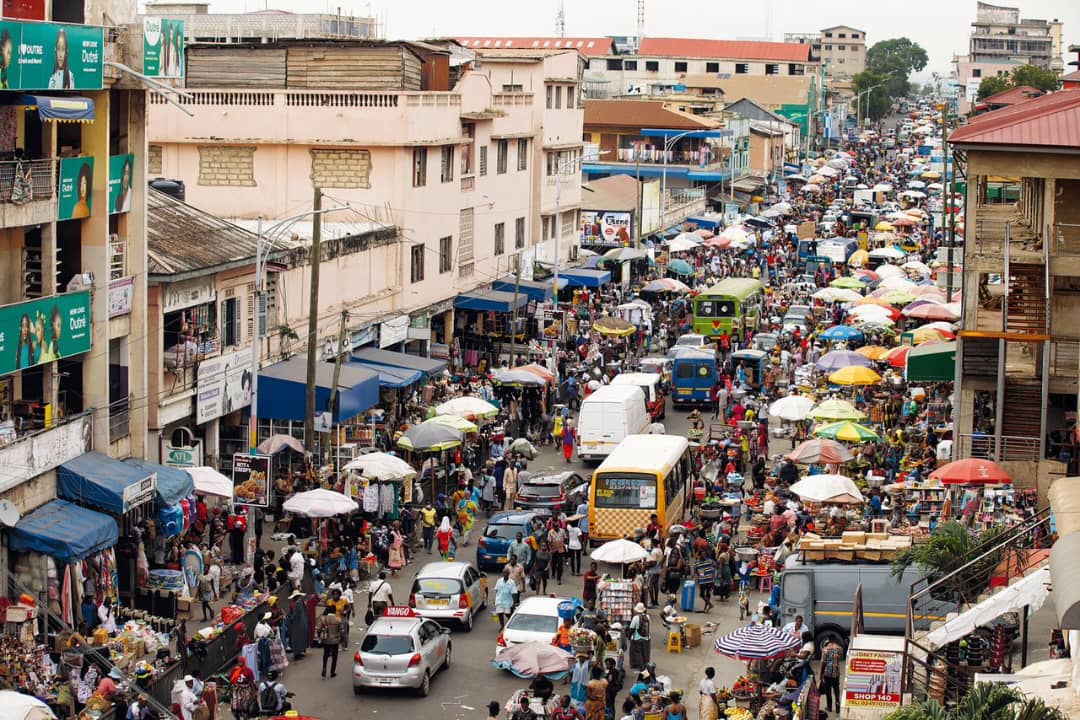
As Ghana Month begins, the nation’s story is shaped not just by culture and history but by its people and its economy.
Ghana’s population has continued to grow steadily into 2026.
With an estimated population of about 35.7 million, the country remains one of the fastest-growing in West Africa, according to IMF projections.
The demographic profile is notably youthful, with a large share under 30 a factor widely seen as both an economic opportunity and a policy challenge for the years ahead.
The expanding population is closely tied to Ghana’s labour dynamics.
Recent estimates place the labour force at roughly 14 million people, with overall participation around 63%, based on datasets from the World Bank and Statista.
Female labour force participation has remained broadly comparable to male participation in recent years, reflecting a relatively balanced workforce.
However, high levels of informal employment and underemployment continue to limit productivity and income growth.
After several years of fiscal strain, economic indicators suggest a gradual recovery is underway.
The International Monetary Fund projects real GDP growth of about 4.8% in 2026, supported by expansion in services, agriculture and ongoing macroeconomic reforms.
Although growth remains moderate compared with earlier highs, the steady trajectory points to improving stability and renewed investor confidence.
Public debt remains central to Ghana’s economic narrative following the 2022 sovereign default.
In 2025, parliament approved a $2.8 billion debt relief and restructuring agreement with creditor nations, according to Reuters.
The deal, alongside domestic debt exchange programmes and continued IMF-supported reforms, is intended to ease debt-servicing pressures and restore confidence in the country’s fiscal outlook.
The labour market remains the critical test of this recovery.
With roughly 14 million people economically active, translating stabilisation into employment opportunities is a key policy priority.
Government plans aim to create up to 800,000 jobs in 2026 through infrastructure development, agro-industrial expansion and youth skills programmes.
Yet development assessments continue to note that job creation has not always kept pace with workforce growth, raising concerns about underemployment among young people.
But there is still hope. Several sectors are emerging as potential engines of growth.
Agriculture and agribusiness remain the backbone of employment, with value-chain enhancement central to long-term growth strategies.
Agriculture is definitely an avenue for young people to create jobs for themselves and others.
At the same time, fintech, communications and other digital services are expanding rapidly, driven by a young and increasingly connected population.
As Ghana marks its heritage this March, the data suggests a nation navigating recovery rather than rapid expansion.
A growing population offers potential but also demands sustained job creation and economic transformation.
The overall outlook is one of measured optimism.
Ghana is neither in crisis nor in a boom, but steadily rebuilding balancing debt sustainability, economic stability and the need to convert its youthful population into long-term growth and opportunity.